
Find Massachusetts Property Records Online
Massachusetts property records are kept at 21 Registry of Deeds offices spread across the state's 14 counties. You can search deeds, mortgages, liens, and other land documents for free through MassLandRecords.com, the official statewide portal run by the Secretary of the Commonwealth. This site covers how to find, search, and get copies of property records in Massachusetts, whether you need a deed copy, want to check a property for liens, or need to trace the history of a parcel across past owners.
Massachusetts Property Records at a Glance
Where to Find Massachusetts Property Records
The main source for Massachusetts property records is the Registry of Deeds. The state runs 21 registry districts across 14 counties. Some counties have more than one district. Middlesex, Worcester, and Bristol each have two or three registries that cover different towns. Each registry handles a specific set of cities and towns. When you want a deed or any recorded document, you go to the registry that serves the town where the property sits.
The Secretary of the Commonwealth's Registry of Deeds division oversees all 21 districts. They maintain the MassLandRecords.com portal, set statewide indexing standards, and provide policy guidance to local offices. Each district is run by an elected Register who serves a six-year term. The Register manages day-to-day operations and is responsible for all documents recorded in that district.
City and town assessors keep a separate set of property records focused on ownership and value for tax purposes. The Registry of Deeds holds the legal documents. The assessor tracks who owns what and what it is worth. Both systems are public and both are useful for different types of property research.
The free statewide portal at MassLandRecords.com lets you search and view records from all 21 districts in one place. Records appear in the system within minutes of being filed at the local registry. The portal is available 24 hours a day, every day of the week. Viewing and printing documents is free at most registries.
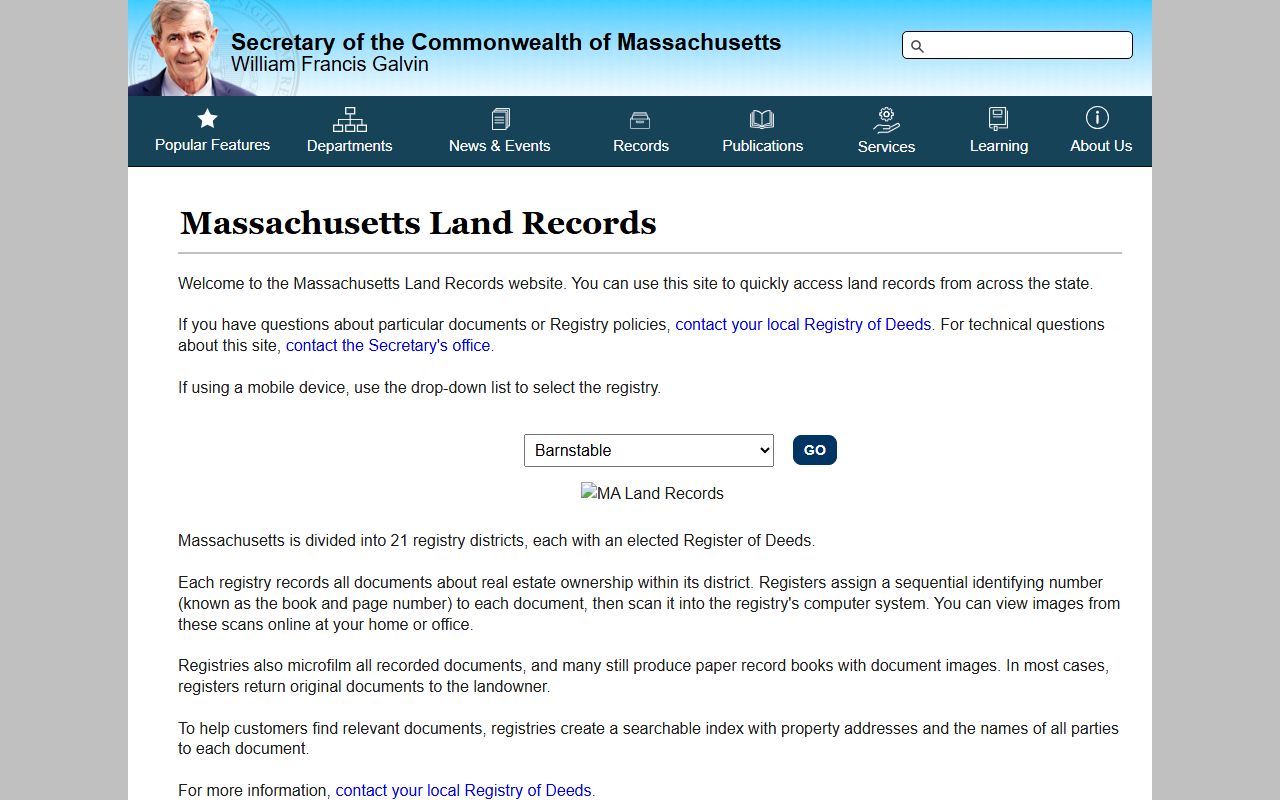
Note: MassLandRecords.com requires pop-up blockers to be turned off for printing. Adobe Reader may not work in Google Chrome for some registries. Use Firefox, Edge, or Safari if you run into display problems.
How to Search Massachusetts Property Records Online
MassLandRecords.com offers several search methods. The name search is the most common starting point. Enter the last name in the Business/Last Name field. You can add a first name and middle name to narrow things down. The Party Type filter lets you choose Grantor (seller), Grantee (buyer), or All. Results appear on the left side of the screen. Click a document number to see the indexed information. Click View Image to see the full scanned document.
The advanced name search adds filters for town and document type. The system has over 100 document types including deeds, mortgages, discharges, homestead declarations, liens, easements, and foreclosure documents. This filter is helpful when a common name pulls up too many results. You can also search by recorded date range to find documents filed in a specific time period. The Book and Page search works when you have a reference from another document. A property address search is available but comes with an important warning: it is not the official index under Massachusetts law. Address search results can be incomplete. Name-based searches are the legally recognized method under MGL Chapter 183.
For very old records, the Unindexed Property Search uses a Book and Page number to pull up documents that were not indexed by name. Middlesex North has records going back to 1629. Suffolk County has document images going back to March 1, 1949, and name-indexed records from January 1, 1973 onward.
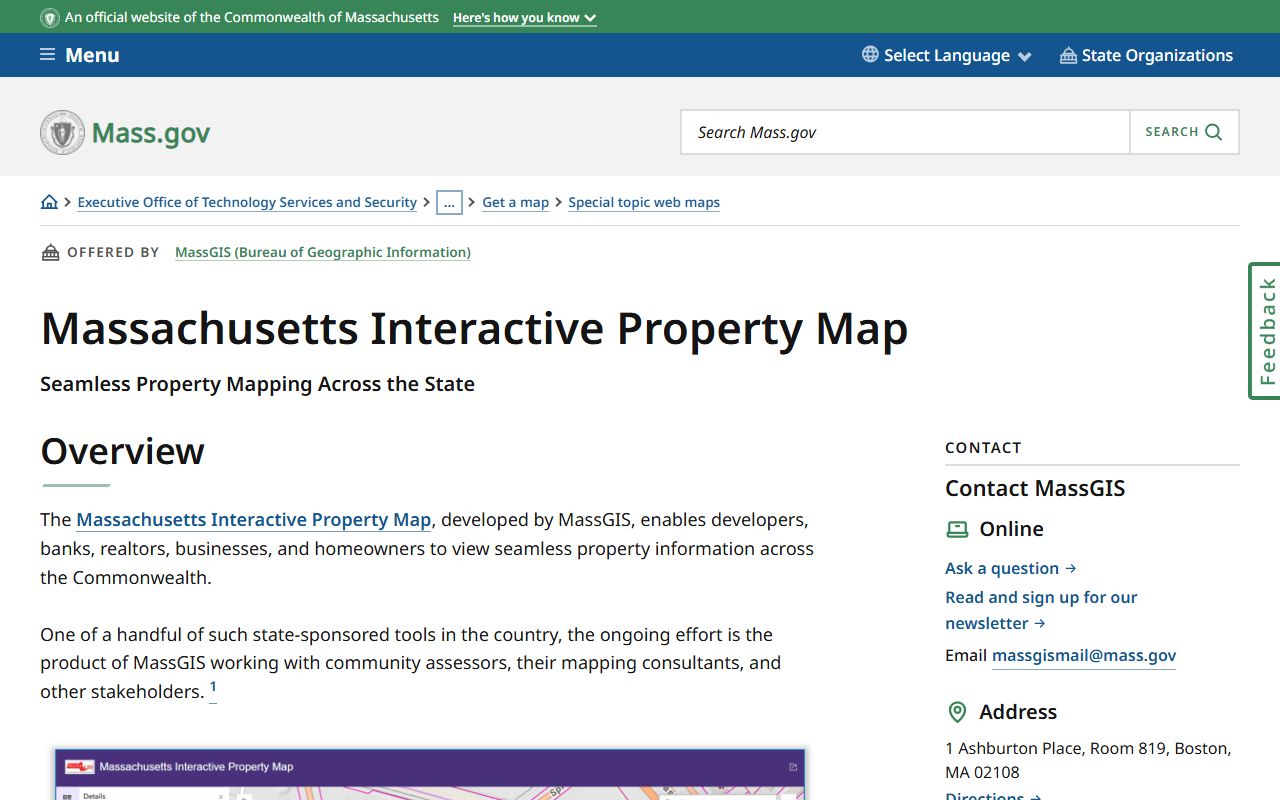
The MassGIS Interactive Property Map is a separate free tool from the state. It shows property boundaries for all 351 cities and towns. Click on any parcel to see owner name, land value, building value, and parcel ID. The map includes aerial photography from multiple years, USGS topographic layers, and street maps. Use it when you know a property's location but not the owner's name. The MassGIS Data Hub lets you download standardized parcel data for any community in GIS format.
Recorded Land vs. Registered Land in Massachusetts
Massachusetts runs two separate land recording systems. Most people deal only with the Recorded Land system, which covers about 80 to 90 percent of all property in the state. Under this system, when property is sold, the deed is recorded at the local Registry of Deeds. The registry assigns a Book and Page number. Title is determined by tracing the full chain of ownership backward through all prior deeds. The standard for a clean title search is generally 50 years. Title insurance is commonly required because the state does not guarantee titles under this system.
The Registered Land system, also called the Torrens System, covers the remaining 10 to 20 percent. Under MGL Chapter 185, the Commonwealth of Massachusetts guarantees these titles. A property owner files a petition with the Massachusetts Land Court. The court appoints a title examiner, hears from interested parties, and issues a Certificate of Title declaring ownership. Section 57 of Chapter 185 states that "the act of registration only shall be the operative act to convey or affect the land." This means you cannot rely on anything not noted on the Certificate of Title. All encumbrances, including mortgages, liens, and easements, must appear on the certificate to be valid against a new owner.
Original documents in the Recorded Land system are returned to the owner after recording. In the Registered Land system, originals stay at the registry. Both types of records are searchable through MassLandRecords.com, though the search screens are separate. The Affordable Homes Act, which took effect February 2, 2025, expanded the rules for voluntary deregistration of land, allowing any property owner to convert from Registered to Recorded Land for any reason through a streamlined 30-day process.
Recording Fees and Copy Costs in Massachusetts
Massachusetts sets recording fees by statute, and they apply the same way at all 21 registry districts. Recording a deed costs $155. Recording a mortgage costs $205. A mortgage discharge is $105. A Declaration of Homestead is $35. Plans cost $105 per sheet. Most other documents are $105 each. Deeds also carry an excise tax of $4.56 per $1,000 of the sale price. On a $500,000 home purchase, the excise tax is $2,280 on top of the $155 deed recording fee.
Viewing and printing documents from the online portal is free at most registries. For certified copies, the fee is $1.00 per page at most locations. Norfolk County charges $2.00 for the first page when requested by mail. Certified copies of Registered Land certificates are $5.00 per certificate. Barnstable County charges $1 per page for copies printed without the watermark overlay. Some registries offer subscription plans for high-volume users who need frequent printing access.
Most registries accept cash and checks only. Make checks out to the Registry of Deeds or the Commonwealth of Massachusetts. E-recording is available at most districts for attorneys and title companies through approved third-party vendors. Some registries require separate checks when recording both Recorded and Registered Land documents in the same submission.
Property Tax Records and Assessor Databases
Property tax records in Massachusetts are maintained by each city and town assessor. The assessor values all real estate for tax purposes. Each of the 351 cities and towns has its own assessor's office. Most have an online database where you can look up assessed values, ownership information, and property details. Common platforms used across Massachusetts include Patriot Properties, MapGeo, AxisGIS, Vision Government Solutions, and Tighe and Bond GIS.
Tax rates vary significantly by community. In FY 2026, residential rates ranged from $6.67 per $1,000 in Cambridge to over $15 per $1,000 in cities like Chicopee and Springfield. Commercial rates are usually higher than residential. Massachusetts allows communities to set different tax rates for residential and commercial property. State law requires assessments at full and fair cash value, though many communities reassess property on a one- to three-year cycle. Some communities like Boston, Somerville, and Waltham offer residential exemptions of up to 35 percent for owner-occupants, which can reduce annual tax bills significantly.
Massachusetts Property Records Laws
MGL Chapter 183 governs the transfer of real property, including requirements for valid deeds, recording procedures, warranty deed terms, and foreclosure deed rules. MGL Chapter 184 covers common law property rules including adverse possession, private restrictions, and marketable title standards. Under Chapter 184, private use restrictions recorded in a deed expire automatically after 30 years unless renewed. This statute of limitations affects title searches and property records directly.
The Massachusetts Homestead Act, MGL Chapter 188, was updated as of August 2024 to provide $1,000,000 in automatic protection of a primary residence from certain creditor claims. You do not need to file a Declaration of Homestead to get the base protection, but filing one at the Registry for $35 provides additional benefits and creates a public record of the protection. Mechanic's liens under MGL Chapter 254 allow contractors and subcontractors to record claims against property for unpaid construction work. These liens appear in property records and must be resolved before a clean title can be conveyed.
The Public Records Law, MGL Chapter 66, gives the public the right to access government records including land records. Agencies must respond to requests within 10 business days. Property records at the Registry are public. No reason or explanation is needed to view or copy them. The Fair Information Practices Act, MGL Chapter 66A, adds some limits on how personal information in government records can be shared or used.
Protect Your Property with Free Fraud Alerts
Most Massachusetts registries offer a free Consumer Notification Service. You register your name and property address, and the registry emails you whenever a document is recorded in your name. This lets you catch unauthorized recordings fast. Most registries let you register up to three properties per account. If you receive an alert for something you did not authorize, call your local registry right away and report the matter to law enforcement.
Watch out for companies that charge $83 to $118 for a copy of your deed. These charges are unnecessary. Every Registry of Deeds in Massachusetts gives you free access to view and print your deed online. You can also call or email the registry and they will send you a free copy. Do not pay third-party companies for documents you can get directly from the government at no cost.
Browse Massachusetts Property Records by County
Each county has its own Registry of Deeds. Pick a county to find local registry contact info, search options, and specific communities served.
View All 14 Massachusetts Counties
Property Records in Major Massachusetts Cities
City and town assessors maintain property tax records and parcel data. Pick a city for local assessor info, online lookup tools, and tax rates.